Inventioneers Full Version
Filimundus ABEducational
4.820.00 Reviews
- Version
- 4.1.8
- Installs
- 10.00K
- Age Rating
- Everyone
Screenshots
Our Review of Inventioneers Full Version
 Analysis by Appyee
I like educational games that let children learn by doing instead of simply tapping through questions, and Inventioneers Full Version takes that idea in a particularly playful direction. It is a construction-and-puzzle game from Filimundus AB where the main activity is creating unusual machines and seeing whether they actually work. The appeal is not just reaching an answer; it is understanding why a moving part, object, or chain of actions succeeds or fails.
That makes it a better fit for curious children who enjoy experimenting than for players looking for a conventional arcade game. I found myself treating each challenge as a small engineering problem: first understand the goal, then place the available pieces, test the result, and adjust one detail at a time. The game is rated for Everyone, which matches its friendly presentation, although younger players may still benefit from an adult nearby when a puzzle becomes difficult.
How the invention workflow feels in everyday play
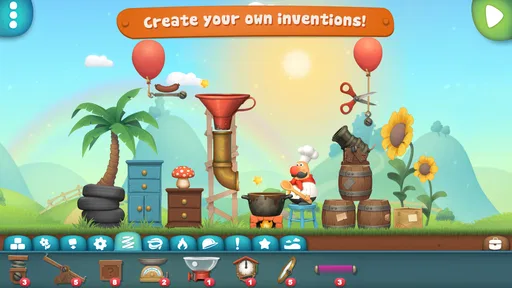
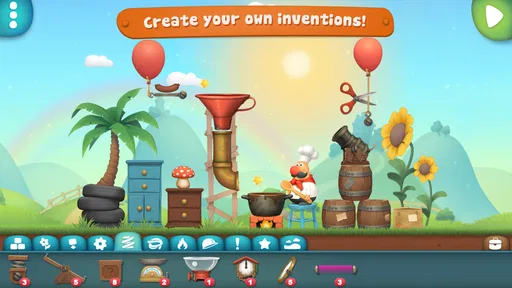
The basic rhythm is easy to understand. A challenge presents a situation that needs a solution, and I build a contraption from the parts available. The fun comes from the gap between a simple objective and the many ridiculous ways a machine might reach it. A successful invention can look neat and logical, or it can work through a chain of surprising accidents. That freedom gives the game more personality than a standard educational quiz.
For a child, the useful lesson is that failure is information. If an object stops too early, the next attempt encourages a change in timing, position, or connection rather than a guess from a list of answers. I would let a child try independently before offering help, because explaining every move removes the most valuable part of the experience: noticing cause and effect.
A realistic family use case is a short after-school session. A child can choose a puzzle, build an attempt, and show the result to a parent without needing a long explanation of complicated rules. The parent can ask, “What do you think will happen if you move that piece?” That turns a few minutes of play into a conversation about prediction and testing, without making the activity feel like homework.
The interface is most enjoyable when I approach it patiently. Rushing through placement can make a failed invention feel random, while pausing to inspect the setup makes the solution easier to reason about. I recommend encouraging children to change one element at a time. That habit makes it much clearer which adjustment helped and which one created a new problem.
There is also a nice creative distinction between building for success and building for elegance. A machine may complete its task while being more complicated than necessary. Trying to simplify it afterward gives experienced players another goal and helps children see that several solutions can exist. I would not insist on the shortest or prettiest construction, though; the strange, overbuilt attempts are often where the biggest laughs happen.
Why the trial-and-error design works
Many educational games reward remembering the correct response. This one rewards observing the result of an action. That difference matters. A child who struggles with reading-heavy activities may still engage strongly with a visual construction problem, while a child who already enjoys science or building toys gets a digital space for the same kind of curiosity.
Compared with a drawing app, Inventioneers gives creativity a clear purpose and consequence. Compared with a traditional puzzle game, it offers more room to improvise. Compared with a coding lesson, it presents logic without requiring syntax or typing. The trade-off is that it does not replace a structured programming course or a detailed physics simulator. Its learning comes through playful experimentation, not formal explanations.
I also appreciate that the game does not need to be treated as a competition. The most rewarding sessions are usually collaborative: one person suggests a change, another tests it, and everyone watches the result. That makes it suitable for siblings or parent-and-child play, although players who want a purely solo, fast-paced challenge may find the slower testing process less exciting.
Settings and habits that make sessions smoother
Before handing the game to a child, I would check the device’s general sound and notification settings. The game is easier to enjoy when interruptions are minimized, especially during a puzzle where the player is watching a sequence unfold. This is not a special in-game trick; it is a simple preparation step that prevents a promising attempt from being missed because another alert appears.
The game is listed for devices running Android 6.0 or later, so compatibility is worth checking before installation. It is a paid title at $5.99 rather than a free download, and that changes how I evaluate it. I would choose it for a child who is likely to return to creative puzzles, not for someone who only wants to sample a game for a few minutes. Paying once can also make the decision feel clearer than starting with an apparently free game and discovering interruptions or extra purchase prompts.
The current version is 4.1.8. I still recommend keeping the device’s operating system and app installation in a normal, up-to-date state, because construction games depend on responsive touch controls. On an older or slower device, precise placement can feel more frustrating than the puzzle itself. A larger screen is also preferable when several parts need to be arranged carefully, while a small phone remains convenient for brief sessions.
For younger children, I would establish a simple routine: choose one challenge, make a first attempt without help, describe what happened, and then decide what to change. This prevents adults from taking over the controls and turns every failed attempt into a useful observation. It also gives the child a repeatable method for difficult puzzles instead of encouraging random tapping.
Another helpful habit is to pause after a successful invention and ask the player to explain the chain in their own words. The explanation can be very simple: one part starts the movement, another redirects it, and the final action completes the task. That small discussion reveals whether the child understood the mechanism or merely stumbled into a working arrangement.
Faster patterns for experienced players
Once the basic workflow becomes familiar, I stop rebuilding everything after every failure. I first identify the part of the invention that clearly worked, then preserve it while testing a change elsewhere. This “keep the working section” approach reduces confusion and makes progress feel more deliberate. It is especially useful when a puzzle contains several moving steps and a complete restart would erase useful information.
I also recommend testing from the beginning of the sequence rather than focusing only on the final target. A late failure may be caused by an earlier action arriving too soon or too late. Watching the whole chain helps separate the original mistake from the visible symptom. This is one of the game’s strongest quiet lessons: the last thing that goes wrong is not always where the real problem began.
A second advanced habit is to build a deliberately simple first version. Instead of trying to create the most imaginative machine immediately, I use the fewest changes needed to test the main idea. If that works, I can add personality or complexity afterward. This is faster than producing a spectacular invention that fails for several unrelated reasons.
Children can also benefit from predicting the outcome before pressing the test control. I would ask them to point to the part they expect to move first and say what should happen next. If the result differs, the surprise becomes a direct clue. That turns the game from passive entertainment into a small cycle of hypothesis, experiment, and revision.
For a group, assigning roles can prevent arguments. One child can describe the goal, another can suggest the next modification, and a third can observe the result. Rotating those roles keeps everyone involved without requiring the game to add a formal multiplayer mode. It is a practical way to use the title as a shared reasoning activity rather than simply passing a device around.
There is a trade-off here. Faster play is not always better play. If a child is enjoying wild experiments, interrupting to optimize every construction can make the game feel like a lesson. I would use the more systematic method only when the player is stuck or specifically wants to improve. The freedom to make a wonderfully inefficient invention is part of the charm.
Where the experience reaches its limits
The biggest limitation is that this is still a game built around prepared challenges. Its creative freedom exists inside the parts and objectives each puzzle offers. A child who wants an unlimited sandbox for inventing anything may eventually want a more open-ended building tool. Likewise, someone seeking detailed engineering rules should look toward a specialized simulation, because the educational value here comes from accessible experimentation rather than technical depth.
The game may also be a poor choice for a player who dislikes uncertainty. Some children prefer one clearly signposted path, while Inventioneers encourages them to test ideas and accept that the first attempt may fail. That is a strength for problem-solving practice, but it can feel demanding to a child who expects immediate success. Gentle guidance helps, but an adult should avoid revealing the solution too quickly.
Another consideration is the paid price. At $5.99, it asks for a deliberate purchase, even though the title’s audience is young. I see that as reasonable when the child enjoys construction puzzles and the family values replaying challenges in different ways. I would skip it if the intended player rarely returns to puzzle games or becomes frustrated whenever an answer is not obvious.
The Everyone age rating makes the game broadly approachable, but age suitability is not the same as skill suitability. A very young player may understand the goal yet need help with precise placement or with remembering the order of events. An older child may solve the basic ideas quickly but still enjoy optimizing or making deliberately funny machines. The best match is a child whose patience and curiosity are at least as strong as their need for speed.
It is also worth setting expectations about what the game teaches. It can support spatial reasoning, sequencing, observation, and persistence. It does not by itself provide a complete lesson in mechanics, coding, or scientific vocabulary. I would use it as a hands-on supplement, perhaps alongside real building materials or a more structured learning activity, rather than presenting it as a full technical curriculum.
Value, audience, and my final recommendation
The public response is encouraging: Inventioneers holds a 4.8 average from around 135 ratings, with 20 written reviews and over 10K installs. Those figures suggest a well-received niche game, although they should not replace thinking about the individual child. A high average cannot make a patient construction puzzle enjoyable for someone who wants action, and a modest install count would not matter to a player who loves this exact style of experimentation.
Filimundus AB has made something more distinctive than a basic collection of educational questions. The game gives children a reason to observe, change a plan, and try again. I especially value the way it supports conversations between adults and children without requiring the adult to lecture. The best help is usually a question about what the player expects to happen, not a direct instruction about where to place the next piece.
I would recommend the Full Version to families looking for a creative educational game that can work in short sessions but also reward deeper experimentation. It is a particularly good choice for children who enjoy building toys, silly machines, visual puzzles, or figuring out why something failed. The purchase makes less sense for players who need constant action, an unrestricted construction sandbox, or formal lessons with explicit explanations.
My strongest practical recommendation is to treat each challenge as a small experiment. Make a simple attempt, watch the entire sequence, preserve what worked, and change only one important detail. When the invention succeeds, ask the player to explain why. That routine brings out the game’s real value and avoids turning it into random trial and error.
After spending time with it, I see Inventioneers Full Version as a thoughtful choice for playful problem-solving rather than a disposable distraction. Its machines are funny, its failures are useful, and its limitations are clear enough to judge honestly. If you want a child to practice thinking through consequences while still feeling free to build something wonderfully odd, this is a game I would be comfortable recommending.
Verdict
Strengths of Inventioneers Full Version
- Creative physics puzzles encourage experimentation and inventive thinking.
- Full version includes the complete set of available levels.
- Whimsical visuals and animations give the game a distinctive style.
- Multiple solutions can make replaying levels rewarding.
- Works well for short play sessions without requiring constant internet access.
Limitations of Inventioneers Full Version
- Some puzzles can feel unclear until you discover the intended interaction.
- Later levels may become frustrating rather than challenging for younger players.
- Controls can feel imprecise when placing or adjusting objects.
- The visual style may appear dated on newer high-resolution devices.
- Limited replay value once the main puzzle solutions are completed.
Other Releases by Filimundus AB
View All
BRIO World - Railway
Educational4.4

My Little Work – Garage
Casual4.2
Similar Picks in This Category
View All
Little Panda Policeman
BabyBus4.0

Monster Trucks Game for Kids 2
Raz Games4.1

Little Panda's Chinese Recipes
BabyBus4.4

Little Panda's Restaurant
BabyBus4.4

Little Panda's Ice Cream Games
BabyBus4.3

Baby Panda Care
BabyBus3.8
Frequently Asked Questions
What is Inventioneers Full Version?
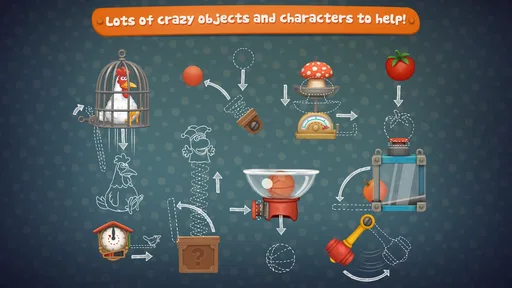
Inventioneers Full Version is a physics-based puzzle game focused on building creative machines to solve increasingly challenging problems. You combine parts such as fans, ropes, wheels, balloons, platforms, and other interactive objects to guide items or characters toward a goal. The full version generally provides access to the complete puzzle experience, rather than limiting players to only a small introductory selection of levels.
How does the gameplay in Inventioneers work?
Gameplay revolves around experimentation and cause-and-effect mechanics. Each level gives you a target and a collection of tools that must be arranged in the correct positions. You can test a design, observe where the machine fails, and then adjust it until everything works. There is usually more than one possible solution, so the game rewards creativity instead of requiring a single rigid answer.
Is Inventioneers Full Version suitable for children?
Inventioneers is generally suitable for children because it uses colorful visuals, simple controls, and problem-solving challenges rather than combat or complicated menus. However, some later puzzles can be surprisingly difficult and may require patience or help from an adult. Parents should also check the store listing for the current age rating, advertising details, in-app purchase information, and privacy practices before downloading.
Does Inventioneers require an internet connection?
The main puzzle gameplay is designed to be playable offline after the application has been installed, which makes it convenient for travel or places with limited connectivity. An internet connection may still be needed for downloading the game, receiving updates, restoring purchases, or accessing any optional online features. Requirements can vary by platform and app version, so checking the official store description is recommended.
Is Inventioneers Full Version free to download?
The availability and pricing of Inventioneers Full Version can differ between Android and iOS, as well as by region and promotional period. Some listings may offer the complete game as a paid download, while others may use a free entry version with additional content unlocked through a purchase. Before installing, review the official store page carefully to confirm the price, included levels, advertisements, and any optional payments.
Play our best games!


